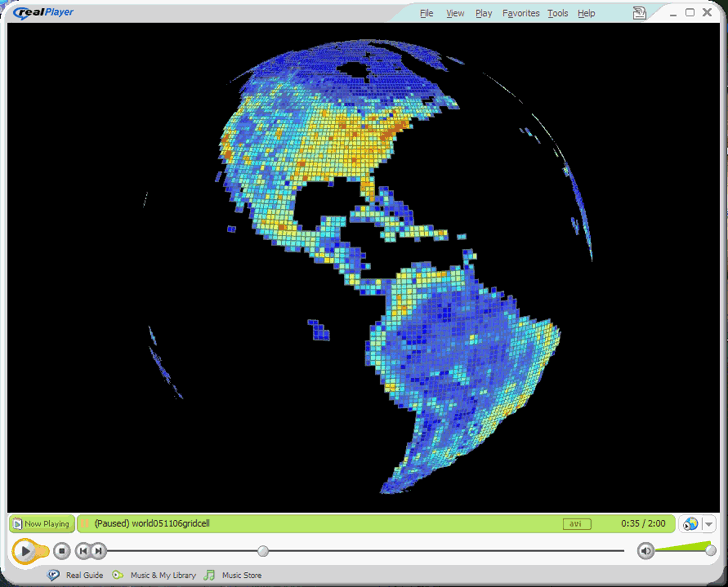
“The G-Econ data set calculates gross value added at a 1-degree longitude by 1-degree latitude resolution at a global scale for all terrestrial cells. These data allow better integration of economic and environmental data to investigate environmental economics, the impact of global warming, and the role of geophysical factors in economic activity. On of the major results is to show that the true economic deserts of the globe are in Greenland, Antarctica, northern Canada, Alaska, and Siberia.”
Downloadable spreadsheet data includes not just economic data, but also environmental data:
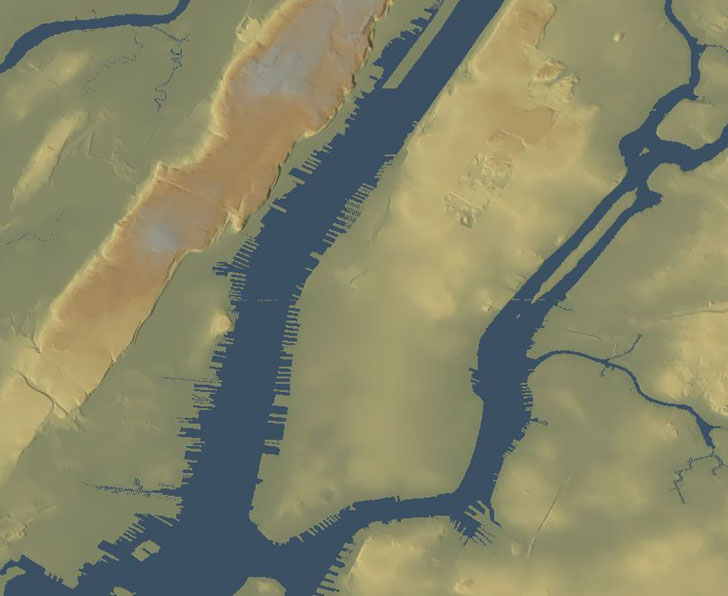
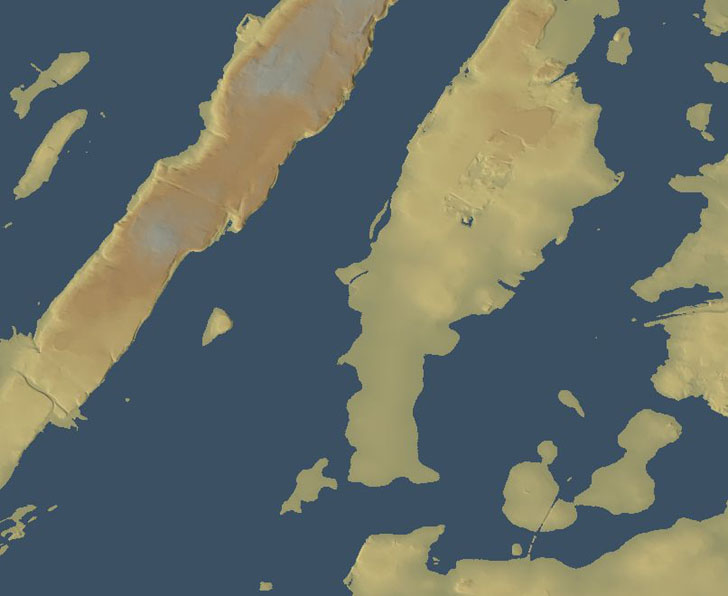
And here’s what it would look like with 8 meters of flooding, due either to a hurricane storm surge or global-warming-induced sea level rise:
The problem with the latter image is that 3DEM did a basin flood, i.e. it filled in all the terrain that was less than 8 meters below sea level, without taking topography into account. For example, a range of hills could lie between some lowlands and the sea, but 3DEM wouldn’t take that natural dam into account. But I also posted an animated flooding map of the same area that did take that terrain blocking into account (click on the “play” button to view the animation):
Today’s post will show how to create such a flooding animation.
NASA’s Goddard Space Flight Center in Maryland maintains the Global Change Master Directory, one of the largest (if not *the* largest) collections of links to data I’ve found on the Internet, somewhere on the order of 15,000. While the header refers to “Earth science data and services”, it’s not limiting itself to the traditional definition of “Earth science” there (i.e. fields like geology, geophysics, meteorology, etc.).
The data is initially divided into 14 broad groupings:
Going to these pages, you’ll find the topics broken down further into subtopics, and even sub-sub-topics. For example, under Climate Indicators, you’ll find sub-topics for:
Modeling and calculating earth’s climate, with the many parameters involved (sun, atmosphere, land, water, snow/ice, etc.), used to be the exclusive domain of supercomputers, and still is for the most complicated models. But there’s a simplified computer climate model available for free for both Windows and Macintosh that lets you run climate models on a desktop PC, and allows you to investigate both past and future climatic scenarios.
Other mapping sites seem to be doing an Earth Day related post, so I’ll move this one up a bit. Energy production from the heat of the earth (geothermal energy) generates no carbon dioxide emissions that contribute to global warming, and could produce as much as 100,000 megawatts in the US alone by the year 2050. Here are some websites with geographic geothermal data, both maps and downloadable data.
18,000 years ago, at the height of the last ice age, much of the Northern and Southern Hemispheres were covered by ice, and the climate and ecosystems were dramatically different. The Review And Atlas Of Palaeovegetation has links to maps and web pages describing the changing climate from 18,000 years and more ago.
The United Nations Food And Agriculture Organization (FAO), AgroMet division, has compiled a database of climatic information gathered between 1961 and 1990 from close to 30,000 observation stations. This database, and applications designed to extract, analyze and map the data, are available online.
Global warming is predicted to increase the sea level by:
About a meter over the next century in the best case (IPCC)
5 meters if the rate of sea level rise continues to accelerate at the same rate it has since 1950 (Hansen)
As much as 12 meters in the worse case (melting/collapse of the Greenland and West Antarctic ice sheets) (Gore)
There is also reason to believe that it will increase the number and intensity of hurricanes, which in turn increases the likelihood of coastal flooding due to storm surges, wind and low pressure combining to drive ocean waters inland. And changes in weather patterns may result in increased flooding events. You can take a look at the potential effect of these events using 3DEM.
Contents of the Free Geography Tools Blog copyright 2007-2018; all rights reserved.
Determining the accuracy, reliability, validity, or appropriateness of any of the software or data written about in this blog for any uses is the sole responsibility of the reader, not the authors of the blog posts. The blog authors have no liability for any uses of the software or data described here.
Shopping at Amazon through the link below helps support the site. Thanks!