

OgleEarth posts about a new KML layer for Google Earth, available from NASA’s OnEarth website, that displays the most recent day’s MODIS (Moderate Resolution Imaging Spectroradiometer) imagery as a Google Earth overlay. Separate overlays from both the Terra and Aqua satellites include:
- Real-color imagery
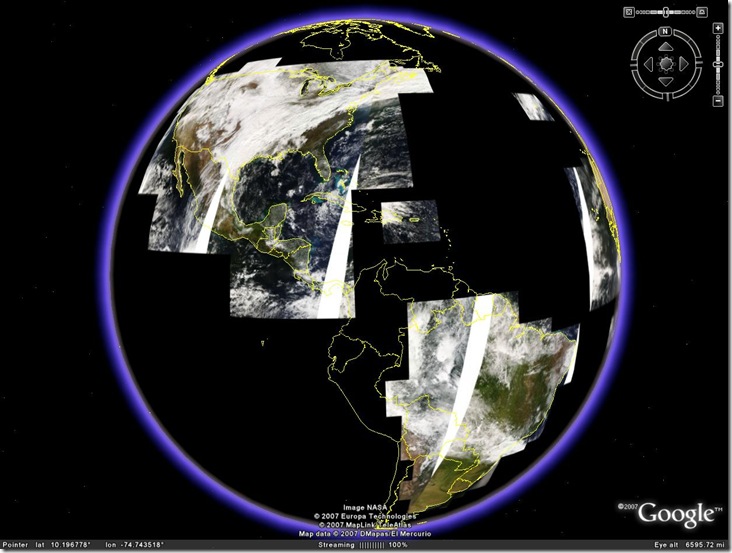
- Pseudo-color (Blue, green and infrared bands)
- NDVI (Normalized Differential Vegetation Index), where the greenest area have the highest vegetation level
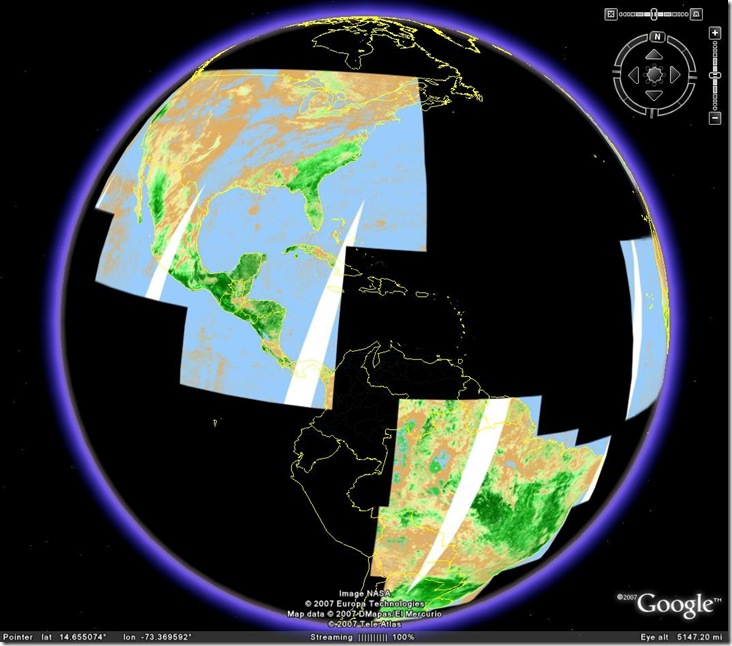
Even with two satellites, Terra and Aqua, MODIS images don’t cover the entire planet over the course of a single day. But over several days you’re likely to see the most up-to-date publicly-available satellite imagery of the surface of our planet. MODIS’s resolution is 250 meters, so don’t except to see whether your car is parked in your driveway on a particular day :).
Other sources of MODIS imagery:
- The OnEarth plugin for WorldWind has added support for this most-recent MODIS imagery layer.
- WorldWind also has a historic MODIS data plugin that lets you view data for a specific date from the past few years.
- There are WMS feeds for MODIS imagery, if you have software that supports WMS.
- The MODIS Rapidfire Website offers downloadable JPGs of this imagery, with worldfiles to georeference it for use in a GIS.