blankblank blank


Converting Text/Spreadsheet Data To Line/Area Shapefiles


Converting point text files to shapefiles is easy; converting sets of text coordinates describing lines and polygons, not so much. I’ve found a way to convert sets of text vertex coordinates into line and polygon shapefiles, but there are some limitations:

  • The sets of vertex coordinate points need to be in the right order, i.e. all the points describing a line or a polygon need to be listed in the order they define a shape.
  • You can only create a single line or single polygon at a time; if you have multiple shapes described by sets of points, you’ll have to generate the shapes one at a time and then merge all the shapefiles later on.
  • No attribute data gets converted - you’ll have to enter it manually for every shape in the final product file. Fun.

The basic process is straightforward:

1. Create a CSV file with the vertex coordinates for the individual shapes. The first row should contain field names for the coordinates (e.g. Lat, Long), separated by commas. This is probably most easily done in a spreadsheet program.

2. Change the file suffix from CSV to TXT.

3. Open the file in DNRGarmin (File => Load From => File, with “Text File” as the file type).

4. Specify the field names that correspond to the spatial information, and click OK.
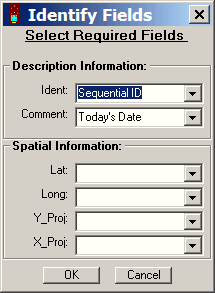
5. Select “Track” or “Route” from the radio buttons above the data table.

6. Choose File => Save To => File; enter a filename, and select “Arc View Shapefile” as the file type.

7. In the pop-up window that shows up after you click OK, specify whether you want the point data to be converted to a line shapefile or a polygon shapefile. Click on OK, and the points will be converted to the specified shapefile type.

Other posts in the GIS Tools series

  1. Converting E00 Vector Data To Shapefiles - A Free And Fairly Painless Approach
  2. Simplifying Line And Polygon Shapefiles
  3. Converting US Census TIGER Data Into Shapefiles For Free
  4. Converting Shapefiles and ArcINFO Coverages To AutoCAD DXF Format
  5. Converting Point Shapefiles To Text/Spreadsheet Format
  6. Converting Text/Spreadsheet Files To Point Shapefile Format
  7. An Easier Way To Convert Shapefiles to Text/Spreadsheet Format
  8. Converting Text/Spreadsheet Data To Line/Area Shapefiles
  9. Full Resolution Raster Map Combining, Subsetting And Export With The TatukGIS Viewer
  10. Viewing Vector Data In The TatukGIS Viewer
  11. The LizardTech Stand-Alone MRSID Viewer
  12. Converting Raster Area Images Into Polygon Shapefiles
  13. SAGA GIS 2.0 Released
  14. ILWIS GIS Is Now Open Source
  15. AVHRR Analysis Add-On For ILWIS
  16. Advanced Image Mosaicking With Regeemy
  17. A Free GIS Viewer (And Cheap GIS Editor) For Windows Mobile Systems
  18. Updates For MapWindow And Saga GIS Programs
  19. Updates For Two Open-Source GIS Programs
  20. Putting Together A Basic Linux GIS Workstation
  21. Free Online Courses For Open Source GIS
  22. GIS-Oriented Linux Distributions
  23. Tabular Terrain Elevation Data
  24. Quick Data Gridding With QuikGrid
  25. A Good Introduction To Geospatial Data Analysis
  26. Converting Digital Elevation Models To Shapefile/DXF Contours
  27. Fixing "Broken" Shapefiles
  28. A Simple DBF Editor
  29. Two Online Vector GIS/GPS/KML Conversion Utilities
  30. Another Shapefile Repair Tool
  31. Quantum GIS (qGIS) Version 0.10 Released
  32. Online Raster Map Georeferencing/Registration With Map Rectifier
  33. Using The Demo Version Of Global Mapper As A Raster/Vector Data Viewer
  34. New Stable Release Of MapWindow GIS
  35. The Big List Of Free Metadata Software I
  36. The Big List Of Free Metadata Software II


Subscribe to this blog's RSS feed

3 Responses to “Converting Text/Spreadsheet Data To Line/Area Shapefiles”


  1. 1 christina

    Converting Text/Spreadsheet Data To Line/Area Shapefiles
    I was wondering, once I have created the list of LAT and Long, how do I make the polygon a specific shape (circular) and size (exactly 75 meters long)

  2. 2 christina

    Thank you for your help.

  3. 3 Leszek Pawlowicz

    I would convert the lat/long list to a point shapefile, re-project it to a metric coordinate system (e.g. UTM), then create a buffer layer area shapefile for the points with the desired radius. If you don’t have a GIS capable of all those steps, MapWindow (www.mapwindow.org) has all the needed tools; do a search on this blog using “MapWindow” for more info.

Leave a Reply


Be sure to enter the "reCAPTCHA" below before submitting your comment.