

Digital Geography suggests a neat way to quickly add voice annotation to Google Earth placemarks. Record your message at Vocaroo.com, and when you’re done, click on the “Post on the internet” link. You can then copy and paste the HTML code directly into the placemark Description section: right-click on the placemark, choose Properties, click on the Description if it isn’t showing, then directly paste the Vocaroo code there. When you click on the placemark, the pop-up balloon will display a Flash player for your audio message.
For more advanced annotation, it would probably be better to record and edit your message in MP3 format, upload it to a web location, then try one of the free embeddable Flash MP3 players described on this page. For example, for the Google Reader MP3 player, take the code:
<embed type=”application/x-shockwave-flash” src=”http://www.google.com/reader/ui/3247397568-audio-player.swf?audioUrl=MP3_FILE_URL” width=”400″ height=”27″ allowscriptaccess=”never” quality=”best” bgcolor=”#ffffff” wmode=”window” flashvars=”playerMode=embedded” />
Note: Don’t copy and paste the above code, as that doesn’t work – copy and paste it from the code box on this website. Replace the “MP3_FILE_URL” section with the full link to your uploaded MP3 file, and then copy and paste the code into your placemark’s description section (same as above). Clicking on the placemark will bring up the balloon showing the MP3 player:
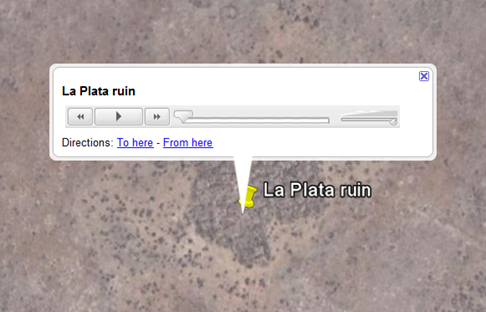
Just click on the play button to hear the message.
i tried to use your instructions but if i paste the code it deosnt work at all
could you help me please!
i’m running an art project using googlemaps and i’d like to add vocarro files
cheers
silvia
Did you go to the website linked in my post, and copy the code text from there? As I note in my post, copying the code directly from my post won’t work.
Neat trick. Works fine in Google Earth. However when I try exporting as kml and importing into Google Maps it leaves out the code. I have the same problem when trying to embed an audio file into a marker in Google Maps directly. Any suggestions or work arounds?
Thx,
Jasper
Try saving it as a KMZ file, and see if that works.
Tried that as well… even though I knew it wouldn’t make a difference :-) Within the kmz/kml file is the following code which calls the mp3 player:
<![CDATA[]]>
However this part is taken out of the description when importing into Google Maps. I know I can achieve this using the Google Maps API, however I want to make it part of a tutorial for students and so want to keep the workflow as easy as possible. Google Maps only seems to allow embedding Google Video or YouTube. Now all the media I would like to be able to add is photos (link from Picasa, Flickr is no problem), video (YouTube will do), audio (could turn into movie and use YouTube but looking for something better) and slideshows (like from SlideShare, for which I can really not think of an alternative)…
So more suggestion? ;-)
Sorry, didn’t correctly add code snippet:
< ![CDATA[ ]] >